| Storage stability |
High stability, minimal degradation6months, 25 °C: 96-99 % residual purity |
Less stable in humidity/heat6months, 25 °C: 85-92 % residual purity |
| Bioavailability/absorbability |
Higher bioavailabilityPeros: ~65-75 % (amorphous) |
Lower, more frequent loss on absorptionPeros: ~10-20 % (normal form) |
| Rate of increase in NAD+ |
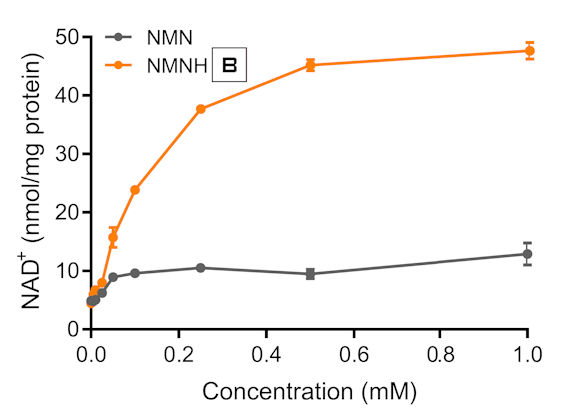
Faster onset ofactionTmax: ~1-2 h |
MoregradualTmax: ~3-4 h |
| Duration of action |
Longer maintenance of NAD+ levelsDuration ofeffect: ~8-12 h |
Shorter effectDuration ofeffect: ~4-6 h |
| Resistance in acidic environments |
Higher resistance in stomach2h, pH 1.2: ~80-90% residual |
Easier degradation2h, pH 1.2: ~50-60 % residue |
| Dose efficiency |
Significant effect even at lower dosesRelativeeffect / 100 mg: ~3-4× |
Usually requires higher dosesRelativeeffect / 100 mg: ~1× |
| Effect on mitochondria |
Stronger support of mitochondrial functionRelativeindex: 4/5 |
Milder supportRelativeindex: 2/5 |
| Antioxidant action |
More significant reduction of oxidative stressRelativeindex: 4/5 |
Does not act directly as an antioxidantRelativeIndex: 1/5 |
| DNA repair support |
Increased support for DNA repairRelativeIndex: 4/5 |
Weaker effectRelativeindex: 2/5 |
| Neuroprotection/Cognition |
Stronger support of brain functionRelativeIndex: 4/5 |
Milder effectRelativeIndex: 2/5 |
| Energy & Vitality |
More significant increase in energyRelativeIndex: 4/5 |
Moderate increaseRelativeIndex: 2-3/5 |
| Immune system |
Better stimulation of immune functionsRelativeindex: 3-4/5 |
Limited effectRelativeindex: 2/5 |
| Stability in enterosolvent form |
Very good (targeted release in the intestine)Release: >80 % |
VariableRelease: ~60-75 % |
| Storage & logistics |
Improved stability in transitLoss ofpotency: ≤ 5% (7 days, 40 °C) |
Higher risk of degradation Loss ofpotency: ~10-20% (7 days, 40 °C) |